
Quick answer
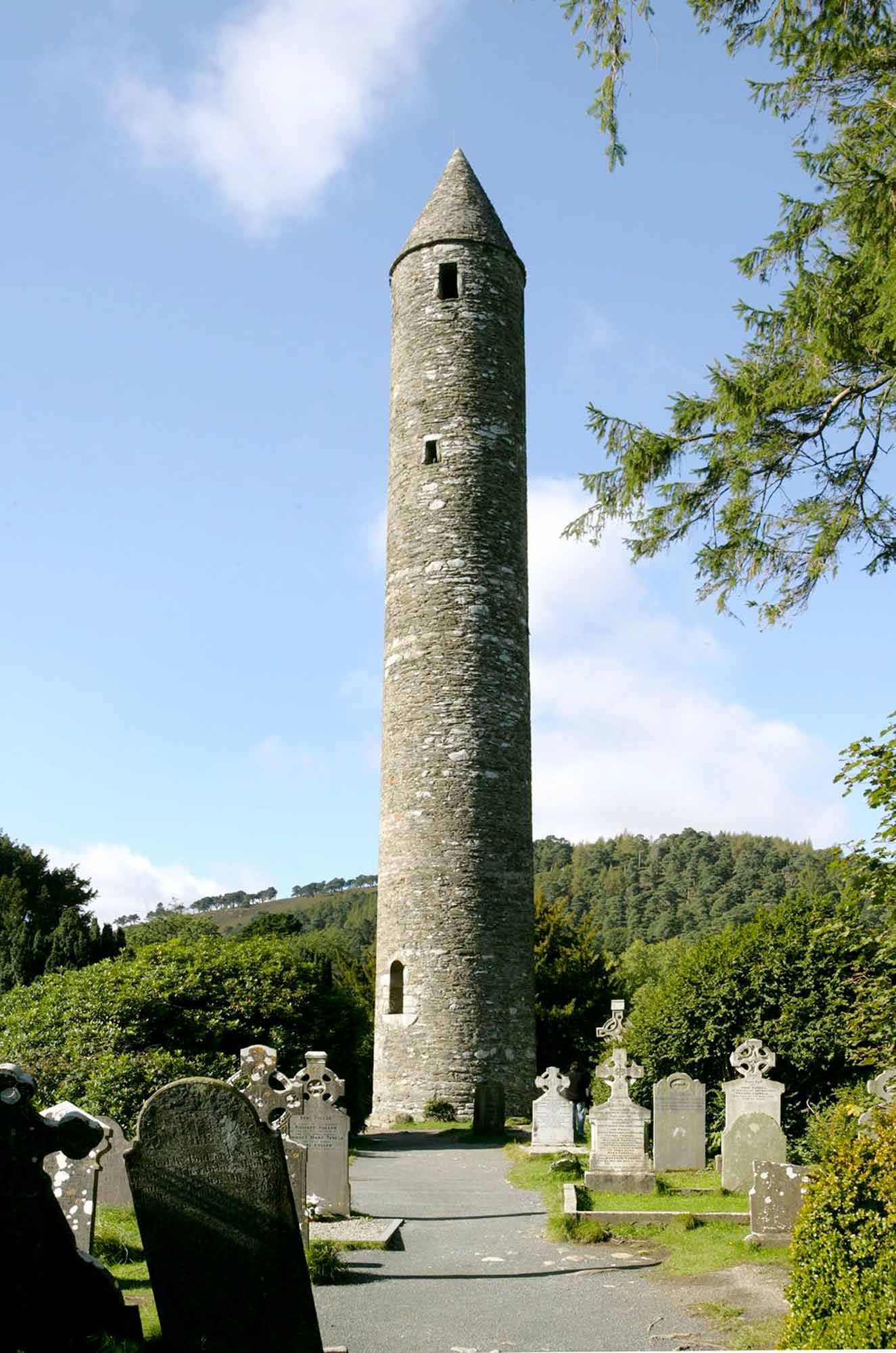
Glendalough is famous for its 6th-century monastic settlement founded by St Kevin, crowned by a round tower roughly 30 metres tall, set between two glacial lakes in a U-shaped Wicklow valley. Adult admission to the visitor centre is 5 EUR, though the monastic ruins and lakeshore paths themselves are open ground. The valley floods with coaches by midday.
The name is a description, not a label: Gleann Dá Loch, the valley of the two lakes. That literal Irish reading explains more about what is glendalough famous for than any brochure line, because almost everything of interest here sits along the axis between the Lower Lake and the Upper Lake, strung out over roughly a mile and a half of valley floor. What a visitor is actually dealing with is three overlapping attractions occupying one site. The first is archaeological — a monastic city founded by St Kevin in the 6th century, of which the round tower, the roofed oratory known as St Kevin's Kitchen, the Gateway, and the cathedral ruins survive in recognisable form. The second is geological: a textbook glacial valley, its U-shape carved by ice, its two lakes divided by an alluvial fan of gravel washed down from the Poulanass waterfall. The third is recreational — the Wicklow Mountains National Park maintains nine waymarked trails from the Upper Lake car park, ranging from a flat lakeshore loop to the Spinc boardwalk climb along the valley's southern rim. Most first-time visitors underestimate how far apart these sit. The monastic ruins cluster near the Lower Lake; the Miners' Road, the Reefert Church and the deer stone lie beyond the Upper Lake, a further twenty minutes on foot. The practical consequence is that the answer to what is glendalough famous for should shape how a day is budgeted rather than merely satisfying curiosity. Travellers arriving on a Kilkenny and Glendalough itinerary typically get ninety minutes to two hours, which covers the round tower, the graveyard and the visitor centre exhibition comfortably but forecloses the Spinc. Independent visitors can reverse the order — walk first, ruins second — and avoid the coach rhythm entirely. Anyone weighing Wicklow Mountains landmarks against each other should note that Glendalough is the only one where UNESCO-calibre early Christian architecture and a national park trailhead share a car park. One last framing point. The site is not curated like a museum; the ruins are unfenced, weather-exposed and free to wander among. Bring boots, expect mud after rain, and treat the monastic city as a landscape rather than an exhibit.
“The ruins cluster near the Lower Lake; the wilder half of the valley begins where most visitors turn back.”
What Is Glendalough Famous For: The Monastic City Highlights
Glendalough is best known for its surviving monastic landscape in the Wicklow Mountains: a round tower, ruined stone churches, a gateway, and the valley setting around the lakes. These are the landmarks visitors come to see first, because they show the scale and layout of the old monastic city in one walkable site.
Glendalough Round Tower
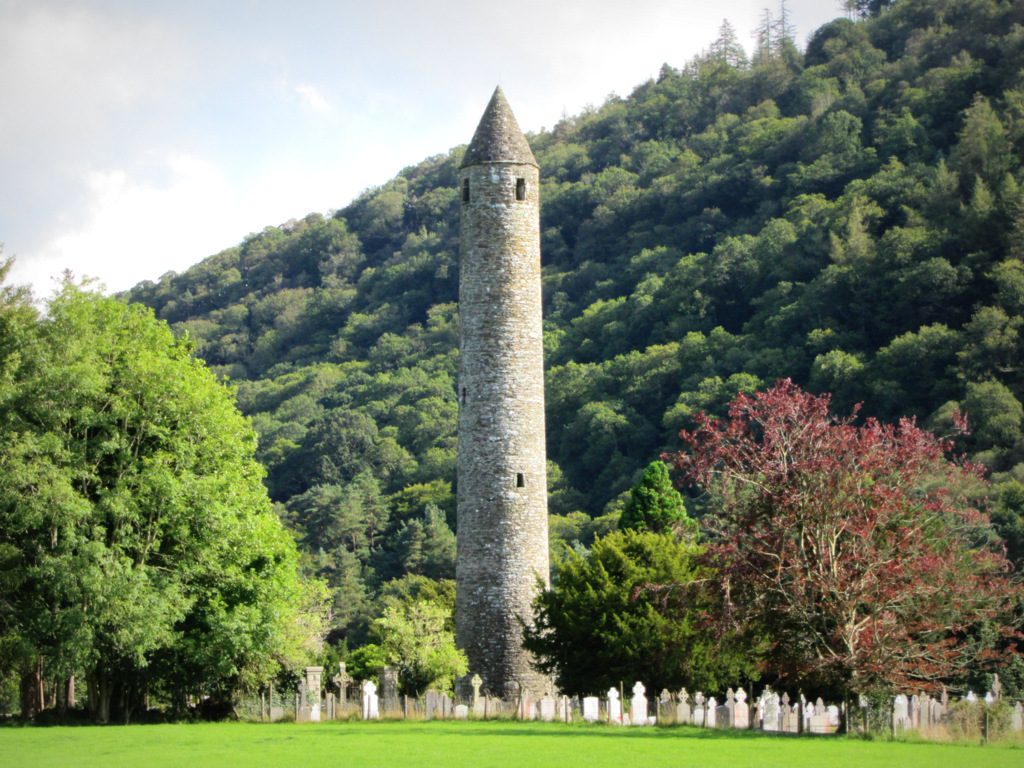
The 30-metre round tower is the most recognisable landmark on site and the clearest symbol of Glendalough’s monastic past. It rises above the valley and gives the site its instantly identifiable skyline.
Stand back for the full height and doorway placement.
St Kevin’s Church
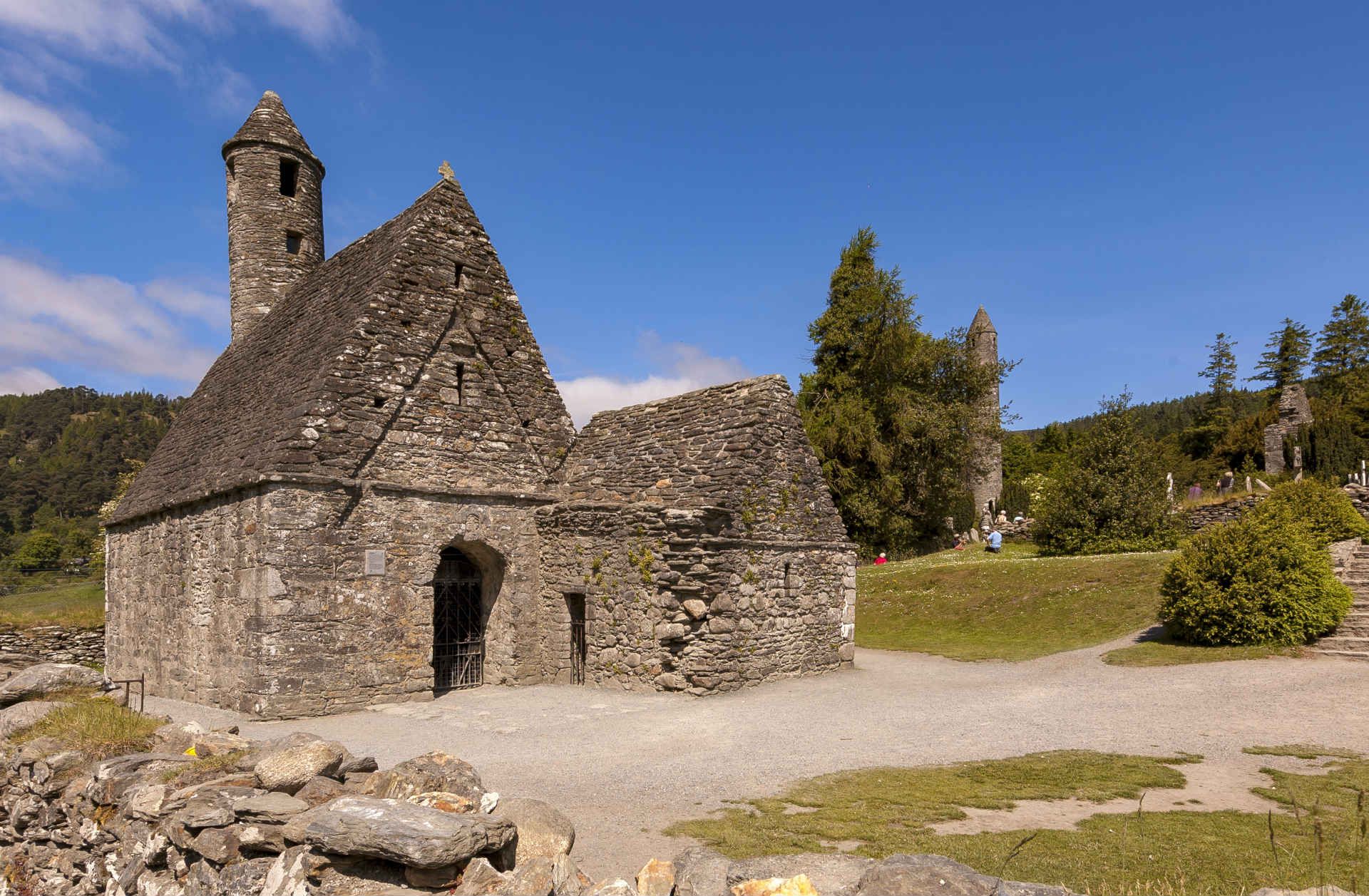
Also called St Kevin’s Church or St Kevin’s Kitchen, this is the church visitors often notice for its intact stone roof. It is one of the few surviving roofed churches in the monastic complex.
Look for the roofed building first, then the small bell tower.
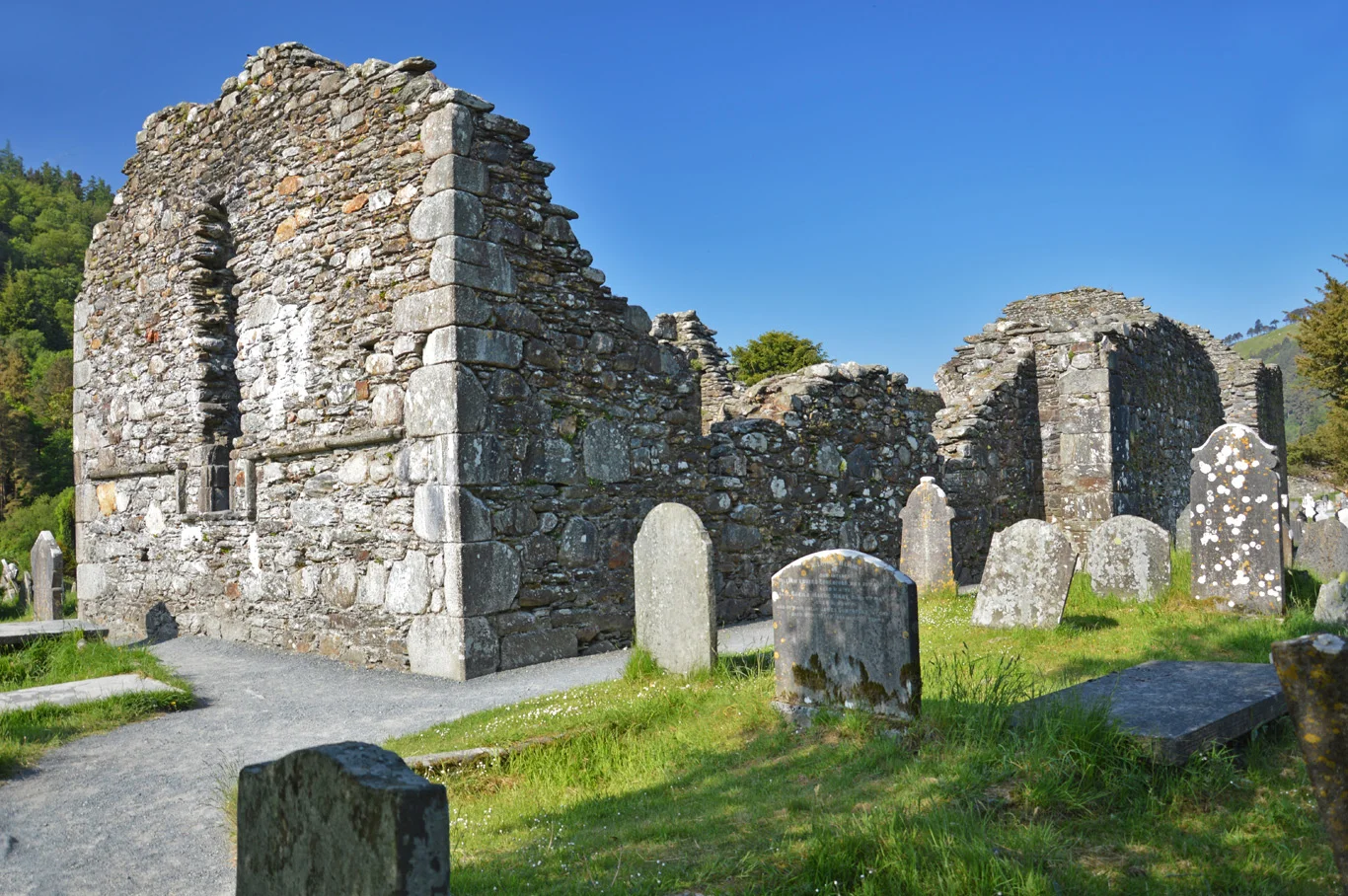
The Cathedral
The Cathedral, or St Peter and St Paul’s, is the largest church ruin in Glendalough and anchors the monastic city layout. Its scale makes it the key place to understand how the church precinct was organised.
Pause at the nave wall to read the building’s full footprint.
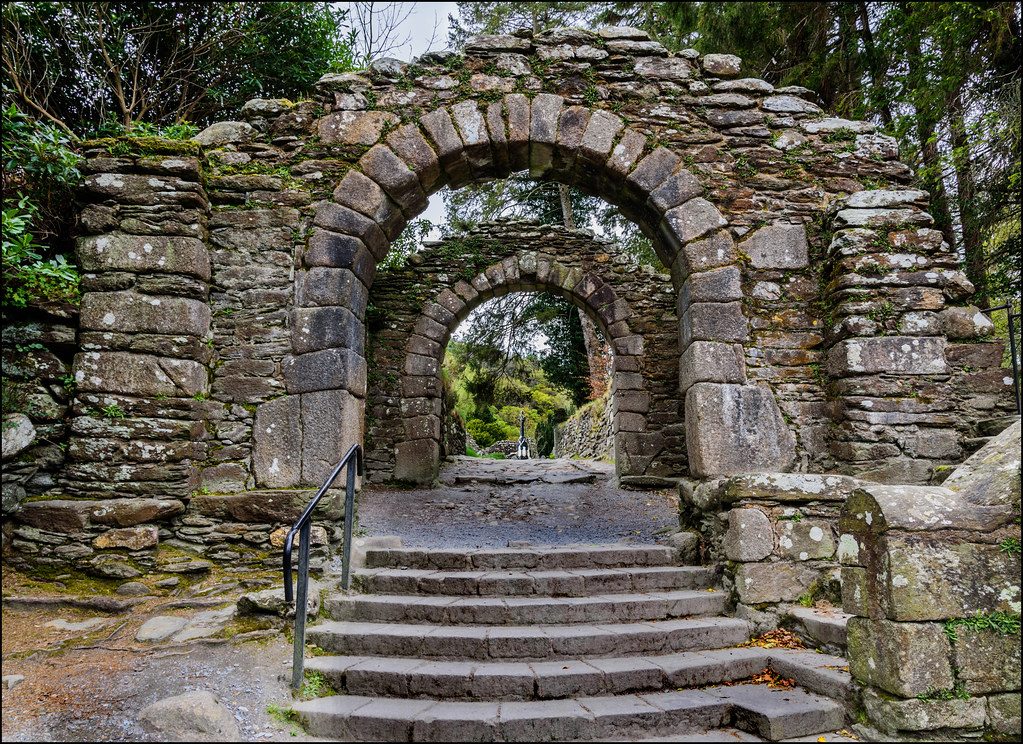
Gateway
The gateway marks the entrance into the monastic enclosure and helps explain how the site was once controlled and approached. It is a practical reminder that Glendalough was a working religious settlement, not just a ruin field.
Walk through the entrance line to see the enclosure plan.
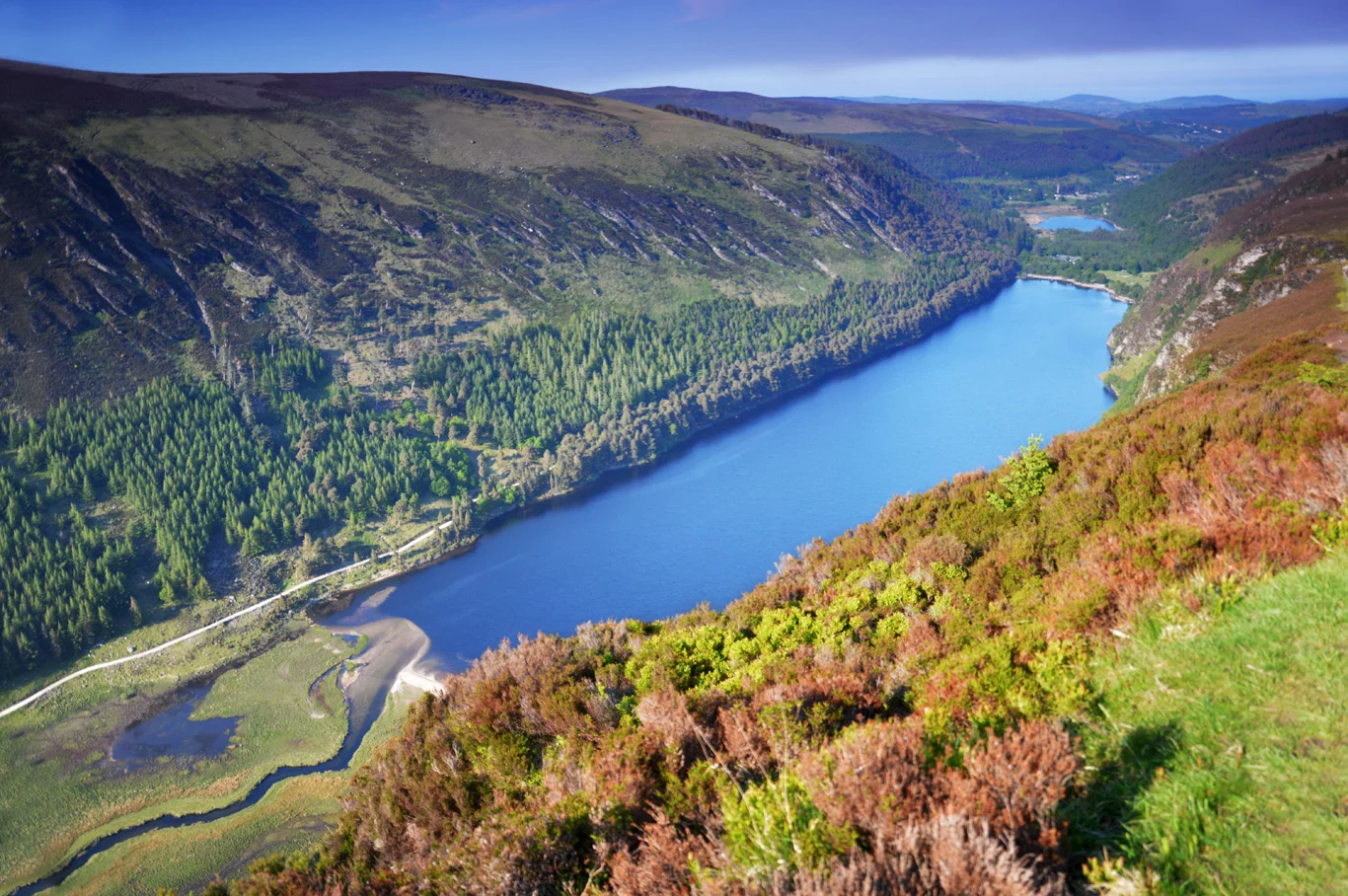
The Monastic Valley
The lakeside monastic valley is part of what makes Glendalough so distinctive, with ruins set inside a glaciated landscape rather than a built-up museum setting. The setting connects the churches, tower, and path network in one view.
Step back toward the lakes for the broadest site overview.
What Is Glendalough Famous For in Irish Monastic History
The valley's story begins in the sixth century, when Kevin — Coemgen in Irish, "of gentle birth" — withdrew to the upper lake beneath Camaderry to live as a hermit. Disciples followed. By his death, traditionally placed at 618, the solitary cell had become a community, and the question of what is glendalough famous for was already being answered in the language of the early Irish church: prayer, learning, and stone. Growth was steady across the eighth and ninth centuries. Glendalough became one of the four principal pilgrimage destinations of medieval Ireland, ranked alongside Rome in the reckoning of the time, with seven visits held equal to one journey to the apostolic city. The monastic city drew students, craftsmen and patrons; its scriptorium and school served a wide hinterland of the Wicklow Mountains. Prosperity attracted violence. Annalists record Viking raids in 834, 977 and again in the eleventh century, and repeated accidental fires, notably in 1163. Each time the settlement was rebuilt. Secular power shaped the later arc. Laurence O'Toole, abbot here before becoming Archbishop of Dublin in 1162, tied Glendalough to the reforming currents of the age. Anglo-Norman expansion followed: in 1214 the diocese of Glendalough was merged with Dublin, ending its independence. English forces under the Lord Deputy burned the settlement in 1398, and the Reformation dissolutions of the sixteenth century closed what remained of monastic life. Pilgrimage nonetheless continued, unofficially, well into the nineteenth century, until the pattern-day gatherings were suppressed in 1862. What survives is unusually complete for an early Irish monastic landscape, which is much of why the glendalough monastic city holds its place among Ireland's heritage landmarks. The round tower, the gateway, the roofless cathedral and the carved crosses stand in a walled enclosure the monks would recognise in outline. Standing among them, a visitor understands what is glendalough famous for not as an abstraction but as fourteen centuries of continuous occupation, ruin, and repair.
St Kevin withdraws to the upper lake and founds a hermitage that draws followers.
Traditional date of Kevin's death, by which the settlement is an established monastic community.
Annals record a Viking raid on the monastic city, the first of several across two centuries.
Laurence O'Toole, formerly abbot of Glendalough, is appointed Archbishop of Dublin.
The diocese of Glendalough is united with Dublin, ending its independent ecclesiastical status.
English forces under the Lord Deputy burn the settlement, hastening its decline.
Reformation dissolutions close monastic life, though pilgrimage to the valley persists.
Church authorities suppress the long-running pattern-day pilgrimage gatherings at the site.
What Is Glendalough Famous For: Key Facts and Records
Glendalough is best known as a sixth-century monastic valley in County Wicklow, set in a glaciated landscape of lakes and mountains. The surviving ruins form one of Ireland’s most important early Christian heritage sites, with several structures that are unusual for both their age and preservation.
6th-century foundation
Glendalough’s monastic settlement began in the sixth century, when St Kevin established a religious community in the valley. Heritage Ireland describes it as a place that became one of Europe’s best-known religious centres.
Glaciated valley setting
The site sits in a glaciated valley in County Wicklow, with the monastic remains spread across the glen. That landscape is part of what gives Glendalough its distinctive identity as a heritage site.
30-metre round tower
The round tower is one of Glendalough’s most recognisable surviving monuments. Heritage Ireland gives its height as 30 metres, and notes that it is a striking landmark visible from far across the valley.
Only surviving gatehouse
Glendalough is known for having the only surviving early medieval gatehouse in Ireland, a rare architectural remnant from the monastic period. This makes it especially important for understanding how large Irish monasteries were organised.
Medieval stone churches
The site includes several medieval stone churches, showing the later development of the monastic settlement. These ruins are part of the wider ‘Monastic City’ remains spread through the valley.
Decorated crosses
Glendalough also preserves decorated crosses, which are among the key early Christian features at the site. They help explain why the valley is so closely associated with Ireland’s monastic heritage.
St Kevin’s Bed
St Kevin’s Bed, a small man-made cave above the Upper Lake, is another recorded feature associated with the site. Heritage Ireland notes that it is linked by tradition to St Kevin, though it may be older than the monastery itself.
What Is Glendalough Famous For: Visitor Centre Opening Hours
Glendalough Visitor Centre is open daily, with the same hours throughout the week. Plan your visit within the official opening window to avoid missing the last entry.
| Monday | 09:30 – 18:00 | Daily schedule |
|---|---|---|
| Tuesday | 09:30 – 18:00 | Daily schedule |
| Wednesday | 09:30 – 18:00 | Daily schedule |
| Thursday | 09:30 – 18:00 | Daily schedule |
| Friday | 09:30 – 18:00 | Daily schedule |
| Saturday | 09:30 – 18:00 | Daily schedule |
| Sunday | 09:30 – 18:00 | Daily schedule |
No seasonal opening-hour changes are listed in the canonical facts provided here. If exceptional closures are announced, check the official Heritage Ireland site before you travel.
How to Get to Glendalough and Why the Arrival Window Matters
Glendalough Monastic Site and Visitor Centre is in Glendalough, Bray, Co. Wicklow, A98 HC80, set in the Wicklow Mountains valley that shaped the site’s approach and visitor flow. The easiest plan is to arrive by car or bus, then follow the signed approach to the Visitor Centre first.
Take the R756 into Glendalough and follow signs for Glendalough Visitor Centre, Glendalough, Bray, Co. Wicklow, A98 HC80
Use a regional coach or local bus service to Glendalough and alight at the signed Glendalough stop/Visitor Centre approach
Approach from the valley trails starting at the Visitor Centre car park area and follow signed paths into the monastic site
Direct drop-off at Glendalough Visitor Centre, Glendalough, Bray, Co. Wicklow, A98 HC80
What Is Glendalough Famous For: Accessibility and Site Conditions
Accessibility is better at the visitor centre than around the monastic ruins. The main site paths are uneven and the outdoor terrain limits full step-free movement, so visitors with mobility needs should plan for partial access rather than barrier-free access throughout.
The visitor centre is the most manageable starting point, but the monastic site itself has uneven ground.
Some areas can be reached more easily than others, but the ruins and paths are not fully step-free.
No lift access is provided for moving around the outdoor monastic site.
Use the visitor centre facilities and ask staff on arrival about the most suitable options.
Guided support may be available at the visitor centre, so contact staff in advance if you need assistance.
Early arrival is usually calmer, which can make movement and wayfinding easier for some visitors.
Check availability
Frequently asked questions about Glendalough fame
Everything you need to know about what is glendalough famous for